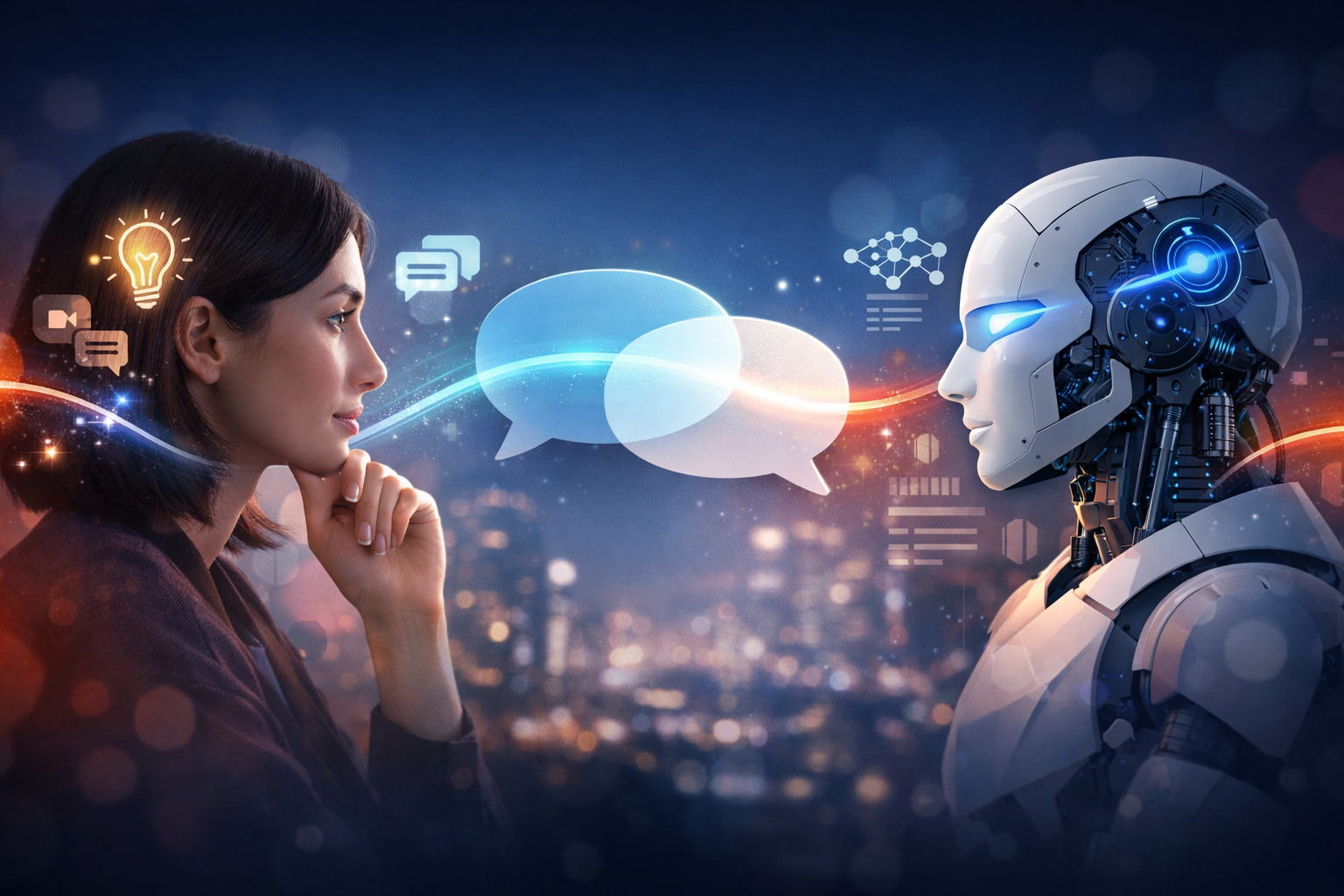
Artificial intelligence and its impact on working life have recently been widely discussed in Finland. Beneath the headlines, a deeper question is taking shape: are we ready not just to use AI, but to work together with it in a thoughtful and sustainable way?
The discussion seems to revolve around three main themes: the relationship between AI and humans, the transformation of work, and collaboration between humans and AI.
In Finnish media, there has been strong attention on the risk of job loss, as well as on ethical questions such as copyright in AI-generated content. In comment sections, concern is tangible. People worry about losing their jobs, about rising unemployment, and about the uncertainty surrounding the kinds of work and skills that may be needed in the future.
When AI changes more than tasks
If AI begins to guide work, learning, and even leisure time, questions arise about individual autonomy and, more broadly, about the role of being human. At the same time, there is a lack of clear direction. There is no widely recognised AI strategy, and it often remains unclear who AI is meant to support, how it should be used, and whether development is fair and ethically sustainable.
From all this, a central question emerges: is Finnish society ready to work together with AI?
The discussion is no longer only about what AI does. It is about what happens to people and society when thinking begins to be shared between humans and machines.
AI may already be part of everyday work. That does not mean people yet know how to trust it, govern it, or build their role around it.
This tension shapes much of the current AI debate.A broader view from around the world
Looking beyond Finland, similar themes appear elsewhere: work and productivity, changing patterns of thinking, and broader questions about who makes decisions, who carries responsibility, and what the human role is.
Recent international research paints an interesting and partly contradictory picture of AI use and attitudes. AI is already widely used. Around two thirds of people are estimated to use AI regularly, while generative AI is spreading rapidly as well.
The benefits are widely recognised. Many people believe AI improves productivity and the quality of work. In practice, it is used especially for writing, analysis, information retrieval, and the automation of routine tasks.
At the same time, trust has not kept pace with adoption. Fewer than half of people fully trust AI systems, and many report using AI-generated content without carefully evaluating it. Mistakes linked to AI are already part of everyday working life.
Adoption without confidence
This creates a clear tension: AI is in use, but it is not fully trusted. It is therefore not surprising that many people call for clearer national and international regulation.
Attitudes also vary between regions. In Europe, the approach is often cautiously optimistic, with strong support for regulation. In Asia and the Middle East, usage is higher and optimism stronger. In the United States, technological development is fast, but public trust remains relatively low.
Overall, the picture is divided. AI is already part of everyday life and its benefits are recognised, yet uncertainty, lack of trust, and the need for guidance remain strong.
Why Estonia offers a useful comparison
This global perspective also helps make sense of the local discussion. But rather than staying at a broad international level, it is worth looking closer to home, at Estonia.
Estonia is an interesting example of a country where digitalisation has advanced rapidly and e-government has been part of everyday life for years. People are used to automation and digital services, which also shapes how AI is perceived. It does not appear as a sudden disruption in the same way as in Finland, but more as a continuation of earlier development.
AI is largely seen as a tool and part of infrastructure. The focus is on how it can be used and how it can support competitiveness. At the same time, there is a culture of experimentation and curiosity. New solutions are put into practice quickly, even if adjustments are needed along the way.
In Finland, the discussion often focuses more on preparation and impact assessment. What might be lost, how should we respond, and what does this mean for us? Work plays a strong role in identity, and within the welfare state there is an expectation that the public sector will guide development through strategy and the education system.
This is not about one being better or faster than the other, but about different starting points. In Finland, change is more often seen as something external, while in Estonia it appears to be more embedded in everyday practice.
What can the individual do?
In this situation, the question is not only about society, but also about the individual.
Perhaps the first step is not to find the right answers, but to change the starting point. Instead of waiting for a clear definition of future skills, I can look at my own work. Where could AI support, challenge, or complement what I do?
This also requires a shift in mindset. AI does not make decisions for me, and I cannot transfer responsibility to it.
My role is changing. I am no longer only a doer, but increasingly a guide, an evaluator, and a collaborator. In practice, this means curiosity and initiative: trying different AI tools, understanding their strengths and limits, and finding what works in my own context.
Perhaps this is not only about learning new tools, but about learning to work in a situation where we no longer think alone.
And for that reason, it makes sense to start now, even if not all the answers are clear.
Would you like to strengthen AI readiness in working life?
Mirai Solution helps organisations build future skills, AI readiness, and human-centred digitalisation so that technology supports work, learning, and sustainable change.