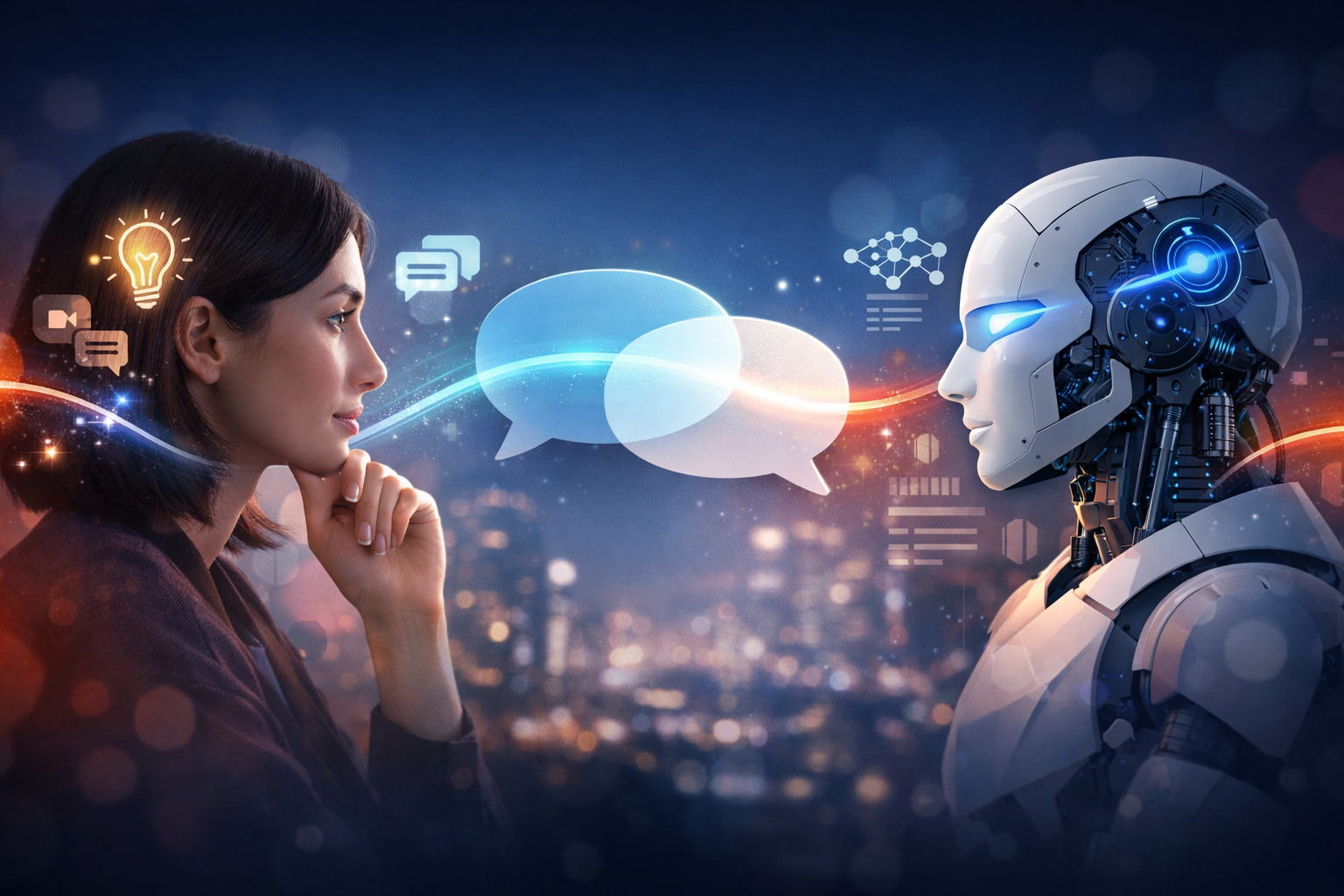
When AI accelerates tasks, processes, and optimisation, the most important question is no longer only what technology can do. It is what teams need to protect and strengthen in themselves.
Digitalisation is accelerating faster than most organisations can adapt. AI is already becoming a silent colleague in many tasks, often before we have had time to fully understand what that means. In the middle of this acceleration, the essential question is no longer what technology can do. The question is what we, as humans, need to be able to do and what we should not lose.
I keep returning to a thought experiment by Oura’s design leader Miklu Silvanto. He imagined a future company with twelve intelligences, nine of them artificial and only three human. Who are those three? His answer was unexpected: a poet, an ethnographer, and a sculptor. Not because these would be the job titles of the future, but because they represent ways of seeing. Ways of interpreting the world, reading people, and creating meaning.
What AI leaves behind
The more I sit with this idea, the more it resonates. When AI takes over the predictable and the optimisable, what remains for humans is the work that requires interpretation, intuition, and depth. Work rooted in lived experience. Work that depends on how we understand each other.
This theme surfaced again when listening to Henri Hyppönen speak about the psychology of future teams. He articulated something that feels increasingly obvious but is still rarely acknowledged: the biggest challenge in the future of work is not technology. It is people. Teams succeed when they feel safe enough to speak honestly, curious enough to keep learning, and connected enough to understand why their work matters. Without this foundation, even the most advanced tools remain unused or misunderstood.
The future team is not defined by how much technology it has, but by how deeply its people know how to listen, interpret, trust, and create meaning together.
That is where human value becomes most visible in the age of AI.Why lived experience still matters
I recognise this deeply from my own experience. For fifteen years, I have been part of a Finnish–Japanese cooperation network that has taught me more about teamwork than any formal training ever could. The success of that collaboration has never depended on tools or platforms. It has depended on patience, trust, cultural humility, and the slow, steady work of building relationships that last. It has been a path, not a project.
When I look at these perspectives together, a clearer picture of the ‘new team’ begins to emerge. It is not a team defined by technology, but a team shaped by depth. A team where human skills are not an afterthought but the centre. A team that understands that AI can accelerate many things, but it cannot replace the ability to listen, to interpret, to imagine, to build trust, or to create meaning.
Relearning teamwork
In practice, this means teams need to relearn something fundamental. They need to listen more carefully, engage in constructive disagreement, and build trust over time. These are not new skills, but they are becoming essential again in a world where much of the work can be delegated to machines.
The organisations that thrive in the coming years will not be the ones with the most technology. They will be the ones that understand what only humans can do. They will be the ones that create environments where people can think deeply, collaborate openly, and explore uncertainty without fear. They will be the ones that treat relationships as assets, not as byproducts.
The most hopeful part of the shift
In that sense, the future team is not more technical. It is more human. And perhaps that is the most hopeful part of this transformation. As AI becomes more capable, it pushes us back toward the skills we have always needed but too often neglected: curiosity, empathy, imagination, and the ability to build something meaningful together.
AI will not replace teams. But it will reveal which teams were never really teams to begin with.
Would you like to build stronger human capabilities for the AI era?
Mirai Solution supports organisations in strengthening future skills, AI readiness, and human-centred collaboration so that technology supports meaningful work rather than replacing what matters most.